
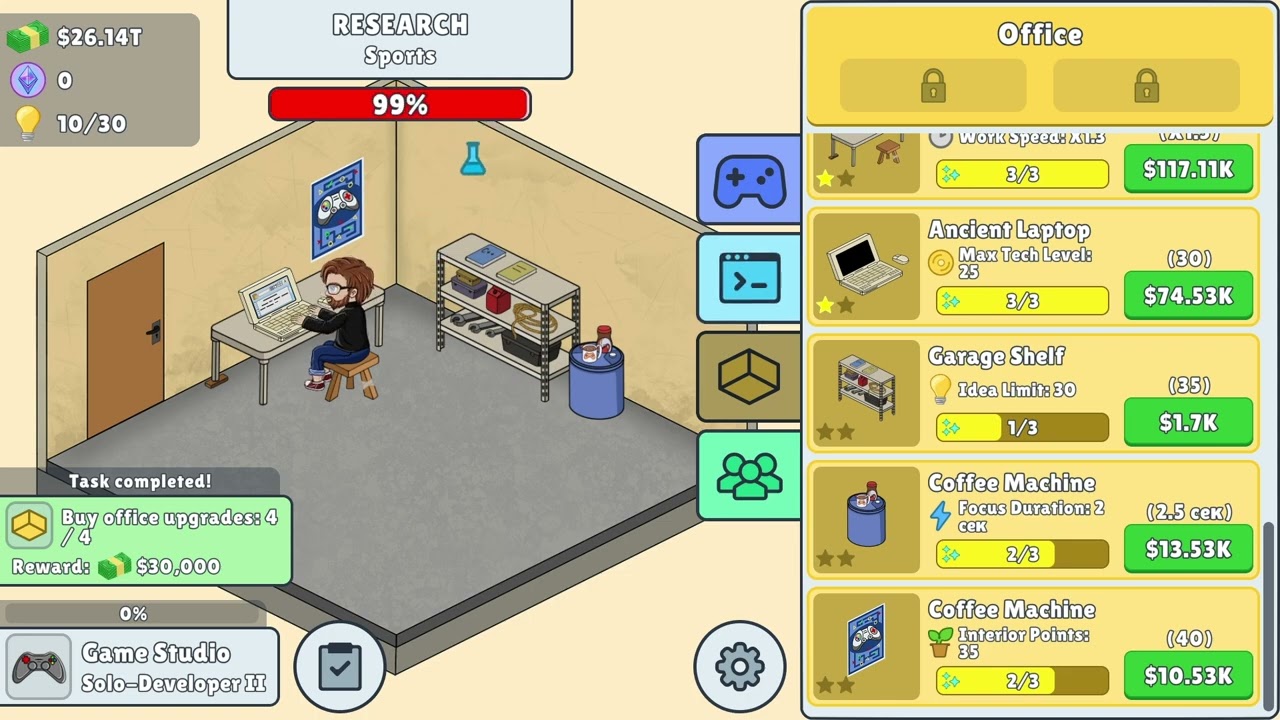
In Idle Game Dev Simulator – Rise to the Top of the Industry!, you start as a solo coder in a dusty garage, juggling concept design, engine upgrades, and user reviews. As your studio grows, you’ll manage genre blending, code optimization, and marketing strategy. Recent updates have introduced an automated QA pipeline feature that generates bug reports over time — letting veteran players lean into passive income and tweak builds mid-run. The delicate balance between creative vision and market trends becomes a constant test of timing and investment.
Idle Game Dev Simulator – Rise to the Top of the Industry!
In the competitive realm of idle and management games, Idle Game Dev Simulator stands out as a surprisingly deep look into the mechanics of building a digital empire. More than just another clicker, it layers intelligent resource systems, incremental automation, and simulated market dynamics to capture the essence of modern game production. Whether you’re optimizing code, balancing creative risk, or managing studio growth, every decision ripples through your virtual company’s success.
The Engine Behind the Empire
At first glance, Idle Game Dev Simulator appears straightforward — click to earn money, hire staff, repeat. But under the hood, it’s powered by a modular progression system that simulates the entire game development pipeline.
Each project progresses through five dynamically scaling phases — concept, development, debugging, marketing, and release.
What makes it compelling is the data-driven balancing layer that adjusts production speed and output based on your resource distribution. For instance, underfunding your “bug testing” phase will speed up development but tank player reviews later. The deeper you get, the more you’ll find yourself fine-tuning systems the way an actual game studio would — trading time, money, and reputation for efficiency.
Upgrades and Automation Systems
Recent updates to the game have expanded the automation framework, introducing adaptive systems like auto-deployment, market forecasting, and code iteration upgrades. These additions don’t just increase idle efficiency — they create a meta-loop that rewards analytical thinking.
-
Auto-QA Pipelines: Introduced in the latest patch, this system autonomously detects “bugs” in your project queue. The longer you let it run, the higher the chance of generating passive “code quality” bonuses, which improve your project’s review ratings.
-
Talent Synergy: Each staff member now has a distinct skill archetype — designers boost innovation, programmers enhance production speed, and marketers scale income potential. Managing their synergy bonuses can dramatically influence your development curve.
-
Market Trend Simulation: Every few in-game weeks, genre trends shift, dynamically affecting sales. Adapting your game portfolio to match these patterns adds another strategic layer beyond pure automation.
Building Your Studio and Brand
What begins as a one-desk operation evolves into a sprawling development studio, complete with department upgrades and employee specialization trees. The studio management layer introduces advanced logistics — balancing server upkeep, PR budgets, and even fanbase expectations.
The latest update also introduced a “Hype Management” mechanic, where you can strategically leak teasers or delay launches to manipulate audience anticipation. It’s a bold addition that mirrors real-world marketing tactics and rewards timing precision.
Community and Competitive Edge
Idle Game Dev Simulator doesn’t exist in isolation — it’s part of a growing ecosystem of simulation enthusiasts who exchange blueprints, meta strategies, and optimization builds online. Seasonal events and leaderboard challenges push players to refine their efficiency, forcing trade-offs between automation, innovation, and creative output.
The developer has also teased an upcoming multiplayer expansion, where studios will compete for publishing rights and cross-promotional opportunities — transforming the idle formula into a semi-cooperative market simulation.
Conclusion – Building More Than Games
What makes Idle Game Dev Simulator exceptional is how it transforms a passive genre into an active lesson in management and optimization. Its layered systems — from adaptive automation to real-time market simulation — elevate it beyond casual play into a satisfying loop of strategic depth.
It’s more than a time-waster; it’s a digital ecosystem that rewards smart investment, long-term planning, and the thrill of watching your virtual studio rise to legendary status. If you’ve ever wondered what it’s like to balance creativity with commerce in the gaming world, this simulator is your next obsession.


