
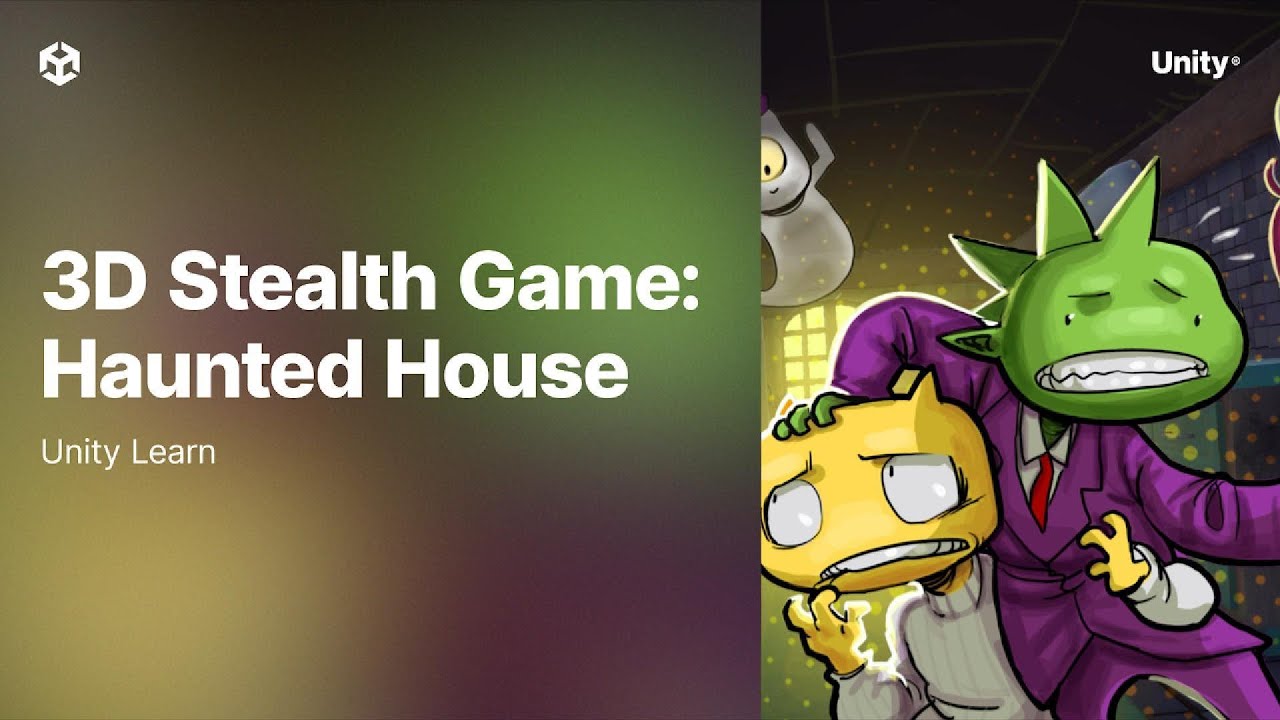
Make a 3D Stealth Game Set in a Spooky Haunted House with Unity’s official Haunted House course on Unity Learn. This hands-on tutorial walks you through essential mechanics like stealth detection, enemy AI, and environmental design, while showing how to layer lighting, audio, and atmosphere for maximum suspense. With updated workflows for Unity’s latest tools, the course combines practical coding with creative design, giving you everything you need to build a chilling stealth experience straight from your browser.
How to Make a 3D Stealth Game Set in a Spooky Haunted House
Conceptualizing a Haunted Stealth Experience
Building a stealth game is about more than hiding in the shadows—it’s about creating a system of tension where every player decision matters. With Unity, the first design choice is defining how your haunted house feels: is it a crumbling gothic mansion or a modern estate with hidden secrets? Unity’s Cinemachine and Timeline tools let you storyboard key scares and cutscenes early, anchoring the game’s tone before you even start coding mechanics.
Building the Haunted House in Unity
The atmosphere of a stealth game hinges on environmental design. Unity’s HDRP (High Definition Render Pipeline) allows you to craft eerie lighting setups, from flickering candles to volumetric fog. Dynamic shadows aren’t just visual—they become gameplay tools, offering cover for players who need to avoid ghost patrols. By combining ProBuilder for rapid blockouts with NavMesh Surfaces for pathfinding, you can design rooms that serve both narrative and gameplay needs.
Each room should feel like a puzzle. A library may use stacked shelves as stealth cover, while the basement might incorporate destructible objects or creaky floorboards that betray the player’s movement. Unity’s Physics system lets you fine-tune these elements, turning ambience into mechanics.
Implementing Stealth Mechanics
At the core of your game are detection systems. In Unity, you can set up AI agents with NavMesh Agents and field-of-view cones driven by raycasts. These ghosts or enemies patrol along waypoints, but more advanced setups can use state machines (via Animator or C# scripting) to give them reactive behavior—hearing footsteps, investigating light sources, or chasing the player if spotted.
Key stealth tools include:
-
Crouching & Peeking: Triggered by simple character controller tweaks.
-
Distractions: Physics objects like bottles or radios can be coded with event triggers to pull AI away from patrol routes.
-
Sound Awareness: Unity’s audio system can simulate proximity-based hearing, forcing players to think twice before sprinting or slamming doors.
Narrative and Replayability
Storytelling thrives in stealth. Unity supports branching dialogue and event systems (e.g., through ScriptableObjects), which you can use to unlock multiple endings—did the player escape undetected, uncover the truth, or fall prey to the house itself? Environmental storytelling—notes, ghostly apparitions, shifting objects—can be scattered via prefab interactions that reveal lore as players explore.
Heightening the Horror
Jump scares alone won’t carry a haunted stealth game. Instead, use dynamic events: a chair sliding across the floor via physics forces, a shadow moving where no enemy exists, or whispers triggered by proximity colliders. By syncing these with Unity’s Post-Processing stack (color grading, vignette, chromatic aberration), you can create a psychological edge that keeps players second-guessing their senses.
Iteration Through Playtesting
Once mechanics are in place, rigorous playtesting is key. Unity’s Profiler and Frame Debugger highlight performance bottlenecks in lighting and AI calculations, ensuring smooth frame rates even in effect-heavy scenes. A loop of testing and iteration helps balance difficulty—whether enemies feel too punishing, or puzzles too obvious. Engaging early testers, especially those who enjoy stealth titles, ensures feedback aligns with genre expectations.
Final Thoughts
Making a 3D Stealth Game Set in a Spooky Haunted House isn’t just about visuals—it’s about fusing mechanics, AI, and narrative into a single tense experience. Unity’s modern toolset empowers developers to blend chilling ambience with tight stealth systems, making every creak, shadow, and decision matter. Done right, your haunted house won’t just scare players—it will keep them coming back for another run through the dark.


