
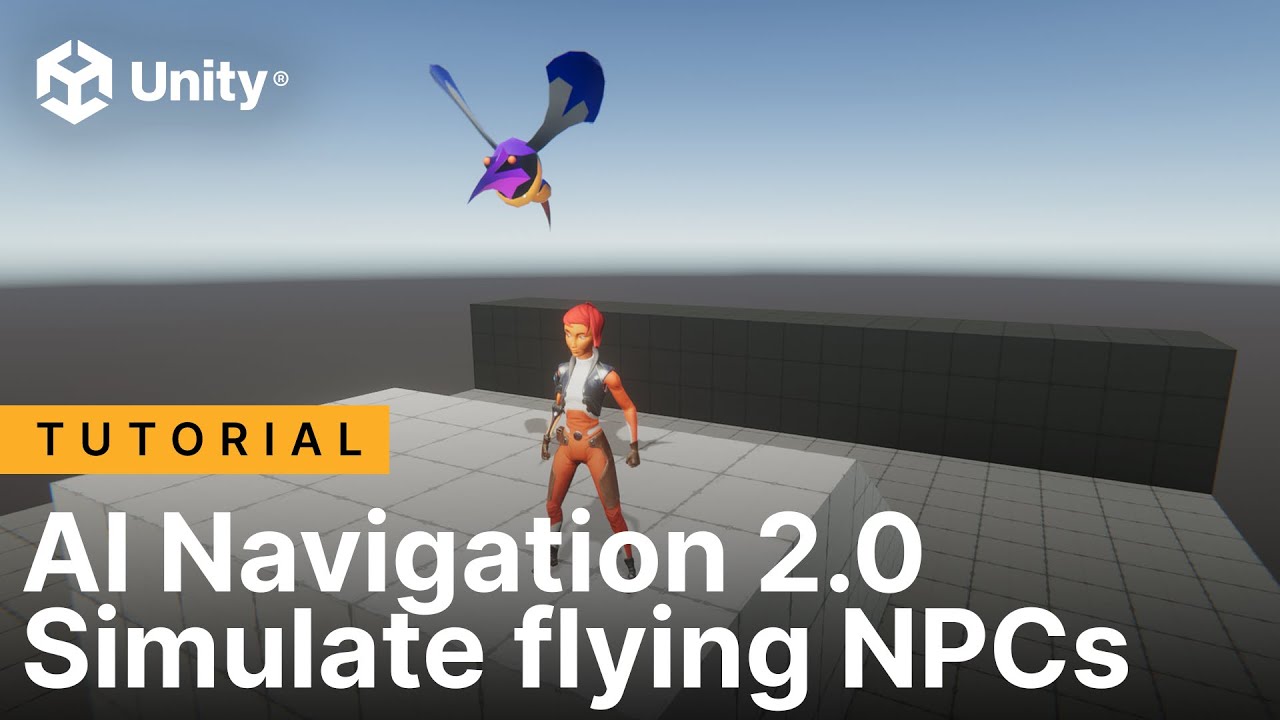
Unity’s AI Navigation package (v2.0.7) upgrades standard pathfinding with dynamic obstacles, NavMesh links, and scene-generated navigation meshes. While primarily geared for ground agents, the system’s tools can be extended: by treating flying NPCs as agents with 3D movement and bypassing ground constraints, you can use off-mesh links or custom agent scripts to let them “fly” over gaps, doors, or vertical spaces. The key is combining Unity’s NavMesh infrastructure with custom movement logic that calculates aerial paths above the mesh—giving you a hybrid of grounded pathing and freeform aerial maneuvering.
Flying NPCs in Unity AI Navigation 2.0 – What Gamers Need to Know
Smarter Navigation, Smarter Worlds
Unity’s AI Navigation 2.0 package isn’t just a rebrand—it’s a complete overhaul of how AI agents move through environments. The system now supports dynamic NavMesh baking, obstacle carving, and off-mesh links with far more flexibility than before. For developers, that means NPCs that can react to changing level geometry on the fly. For players, it translates into smarter AI opponents and allies who behave less like scripted robots and more like reactive actors.
From Grounded Agents to Flying NPCs
By default, NavMesh agents think in two dimensions: walkable ground, ramps, and staircases. To create flying NPCs, developers extend the NavMesh logic vertically. This is done using:
-
Off-Mesh Links: Create virtual connections that let NPCs “jump” between layers—repurposed here as flight corridors.
-
3D Agent Movement Scripts: Instead of constraining agents to NavMesh normals, scripts recalculate position in 3D space while still using NavMesh pathfinding for destination logic.
-
Layered NavMeshes: Some teams build stacked NavMeshes at different heights, letting flying NPCs swap between altitude “lanes” like air traffic.
For gamers, this means enemies that don’t just chase you around corners—they can dive through windows, hover above chokepoints, or flank you from vertical angles.
Dynamic Environments and Performance
One of the biggest upgrades in AI Navigation 2.0 is runtime NavMesh generation. Destructible environments, collapsing floors, or moving obstacles can now be baked into navigation in real time. For flying NPCs, this enables reactive aerial maneuvers—dodging falling debris, weaving around collapsing towers, or adjusting altitude when a roof caves in.
Performance is optimized with carving obstacles and smaller NavMesh regions, so even large scenes with dozens of moving agents can maintain stable framerates. The result is a more believable, scalable simulation for both indie projects and AAA-scale shooters.
Why This Matters for Gameplay
For gamers, the practical impact is clear: fights become less predictable. Flying NPCs powered by Unity AI Navigation aren’t locked to rails—they can surprise, adapt, and react dynamically. Imagine a stealth mission where drones actually sweep rooms based on line-of-sight logic, or a boss fight where aerial minions reposition in real time instead of following pre-set patterns.
This blend of pathfinding precision with creative AI design opens the door to richer combat scenarios, emergent gameplay, and environments that feel alive.


