
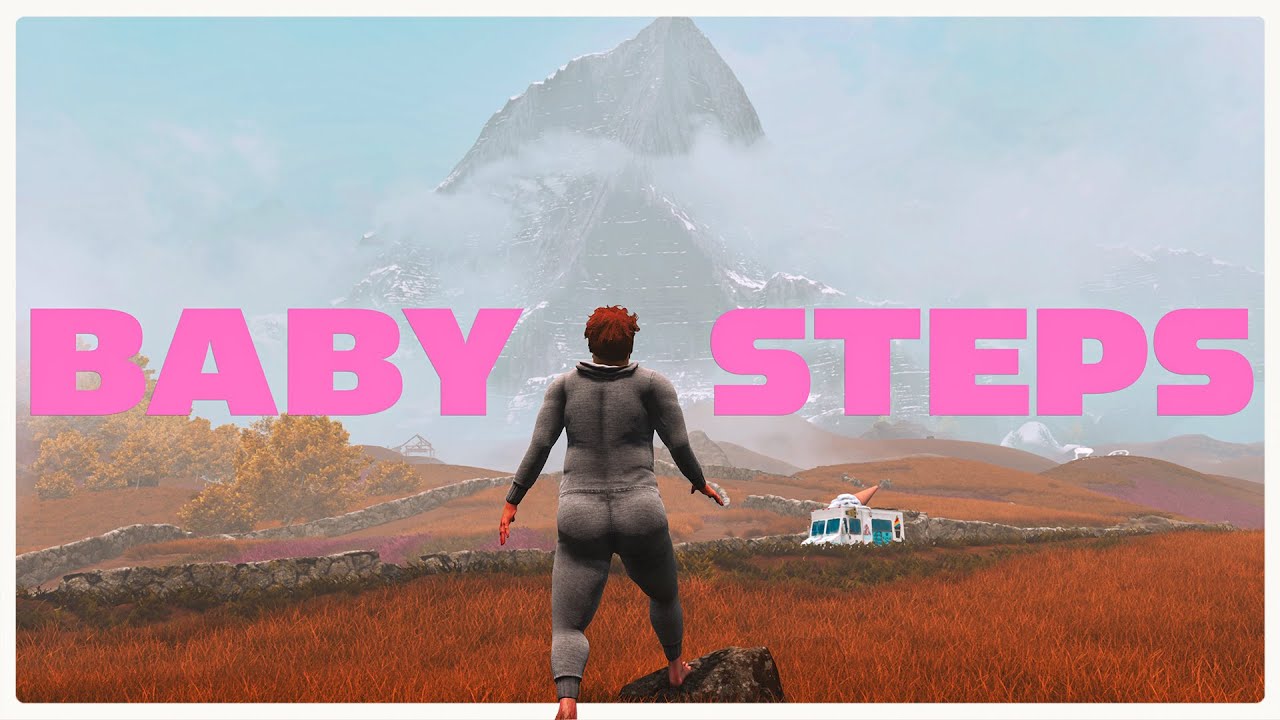
In Baby Steps, stumbling isn’t just part of the joke—it’s the core mechanic. You control Nate’s legs separately (analog triggers for each foot, plus stick input for lean and direction), making even a gentle slope feel like tightrope balancing. The free demo reveals just how much the game leans into physics-driven feedback: mud slows you, wet rocks make footing unpredictable, and the smallest misstep can cascade into a full tumble. Yet it’s also forgiving—there’s no permanent damage, and you’ll quickly pick up momentum under the right flow. It’s absurd, awkward, and oddly meditative; exactly what the creators behind QWOP and Getting Over It set out to do.
Baby Steps – Why This Hilariously Awkward Game Is Wilder Than You Think
Few games dare to make walking the star of the show, but Baby Steps embraces the absurdity and turns it into a full-blown adventure. Developed by Gabe Cuzzillo, Bennett Foddy, and Maxi Boch, the team behind Ape Out and Getting Over It, this physics-driven oddity asks players to master something we usually take for granted: putting one foot in front of the other. The result? A game that’s as technically fascinating as it is hilarious to watch.
Core Mechanics: The Science of Stumbling
At its heart, Baby Steps is a walking simulator in the most literal sense. Each leg of protagonist Nate is controlled independently with the analog triggers, while the sticks manage lean and momentum. This means every step is a mini-physics puzzle: too much lean, and Nate face-plants; too little, and he shuffles in place like a malfunctioning puppet.
The physics engine is tuned to exaggerate mass, inertia, and surface resistance. Mud drags your feet, wet rocks reduce traction, and even a simple downhill slope can turn into a free-falling disaster. Success demands rhythm and muscle memory — mastering the flow between push-off, lean, and balance.
Environments as Obstacles
The demo and recent updates highlight how varied terrains aren’t just set dressing but active mechanics. Uneven paths shift your center of gravity, ropes and platforms require swing-timing, and snowy hills add sliding vectors that force reactive counter-leans. Every environment plays with different physics multipliers, keeping movement unpredictable but deeply learnable.
The Appeal of Failing Forward
Like Getting Over It, frustration is part of the fun. Failures aren’t punishments but slapstick payoffs — ragdoll tumbles, unexpected pratfalls, and over-dramatic recoveries. Yet beneath the comedy is a serious loop of mastery. Players who learn to read the terrain and anticipate momentum discover a meditative rhythm that transforms chaos into flow.
Presentation and Humor
Visually, Baby Steps leans into simplicity: chunky models, exaggerated animations, and pastel-colored backdrops. The audio sells the comedy — grunts, slips, and stumbles sync perfectly with player inputs, while the soundtrack alternates between laid-back tunes and sudden bursts of awkward silence when you fall flat on your face.
Conclusion: More Than Just a Joke
Baby Steps is equal parts absurd gag and finely tuned physics experiment. By giving full control over something as simple as walking, it creates a game that is both technically fascinating and endlessly entertaining. For players who love the mix of frustration, physics mastery, and unexpected hilarity, Baby Steps is a stumble worth taking.

